THANK YOU FOR SUBSCRIBING

What is the Bottoms Up draft beer system and how does it function?
By now, you may have encountered a Bottoms Up draft beer system either in person or through one of the countless social media videos showcasing a beer magically filling from the bottom.
What exactly is the Bottoms Up draft beer pouring setup?
In this article, we will cover its mechanism of action, which types of operators would benefit from installing one, and which ones would be better off skipping it.
The Bottoms Up system stands out as a highly creative and forward-thinking solution in the realm of professional draft beer service. Yet, at the end of this article, you will see it’s not for everyone.
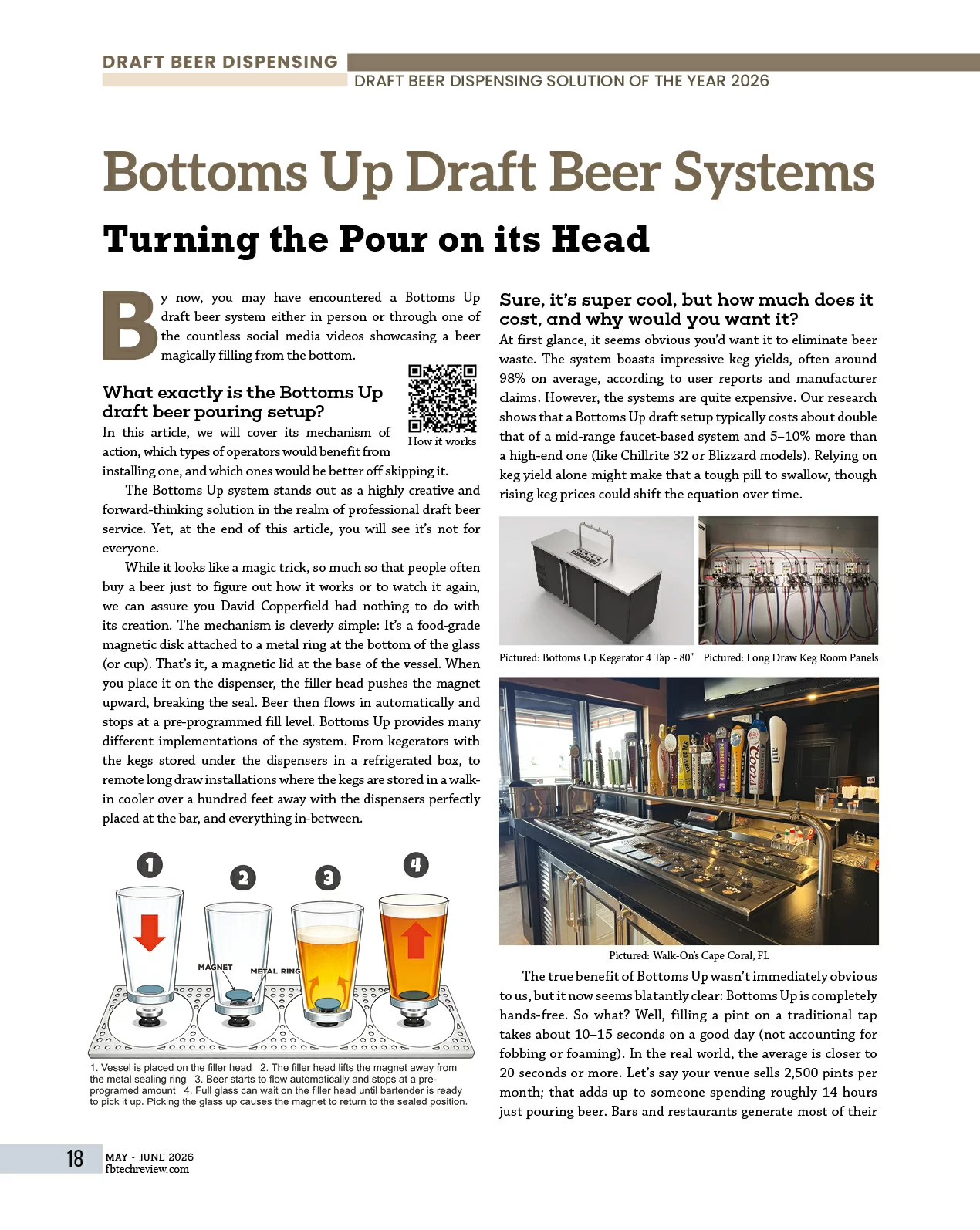
While it looks like a magic trick, so much so that people often buy a beer just to figure out how it works or to watch it again, we can assure you David Copperfield had nothing to do with its creation. The mechanism is cleverly simple: It's a food-grade magnetic disk attached to a metal ring at the bottom of the glass (or cup). That's it, a magnetic lid at the base of the vessel. When you place it on the dispenser, the filler head pushes the magnet upward, breaking the seal. Beer then flows in automatically and stops at a pre-programmed fill level. Bottoms Up provides many different implementations of the system. From kegerators with the kegs stored under the dispensers in a refrigerated box, to remote long draw installations where the kegs are stored in a walk-in cooler over a hundred feet away with the dispensers perfectly placed at the bar, and everything in-between.
 How do cost, keg yield, and labor savings impact the system’s return on investment?
Sure, it's super cool, but how much does it cost, and why would you want it?
At first glance, it seems obvious you'd want it to eliminate beer waste. The system boasts impressive keg yields, often around 98% on average, according to user reports and manufacturer claims. However, the systems are quite expensive. Our research shows that a Bottoms Up draft setup typically costs about double that of a mid-range faucet-based system and 5–10% more than a high-end one (like Chillrite 32 or Blizzard models). Relying on keg yield alone might make that a tough pill to swallow, though rising keg prices could shift the equation over time.
 The true benefit of Bottoms Up wasn't immediately obvious to us, but it now seems blatantly clear: Bottoms Up is completely hands-free. So what? Well, filling a pint on a traditional tap takes about 10–15 seconds on a good day (not accounting for fobbing or foaming). In the real world, the average is closer to 20 seconds or more. Let's say your venue sells 2,500 pints per month; that adds up to someone spending roughly 14 hours just pouring beer. Bars and restaurants generate most of their business during customer rushes: About 85% of revenue in the industry comes in perhaps a four-hour window each day. For easy math, if a restaurant does $1,000,000 in annual sales, one of those peak hours is worth about $582. Meaning that if Bottoms Up frees up your staff's time, you could potentially drive an additional $8,400 per month in revenue.
This obviously depends on customers wanting to buy more, but if you break it down, it would mean selling an additional $280 in food and beverages per day. If your staff is saying “How can I help you?” instead of “I'll be with you as soon as I'm done pouring these beers…,” that number is not hard to imagine; in fact, it starts to sound a little low. One of the proprietors we spoke with when doing research for this article said, “You wouldn’t have your staff rolling silverware or cutting citrus in the middle of their shift, would you? Why would you make them stand there and pour beer?” His point being those are things that don’t take very long but would be insanely disruptive if you did them as needed for every customer.
Bottoms Up has developed an ROI calculator that does a great job of simplifying it.
Here is an example of its results.
How many hours per day are you busy? = 4
Do you think freeing your staff from the taps could help you sell a few more items per hour? If yes, how many? = 6
What would be the average profit on each of those items (rough math)? = $6.00
4 Hours x 6 Items x $6 = $144
Days open? 360
360 Days x $144 = $51,840
$51,840 additional profit annually.
Here is a link so you can play with it yourself:
How do beer waste reduction and magnet usage affect overall financial outcomes?
Does the saving in beer waste make it make sense?
Let’s crunch some numbers. The average price of a keg is around $200. On average, about 20% of a keg is wasted in many venues. If you sold 2,500 pints per month, Bottoms Up would save you approximately $800 per month in wasted beer. It would also mean 20% less downtime due to blown kegs. Kegs always seem to blow at the height of service, so this is a pretty big positive, though we aren’t really sure how to put solid numbers to it.
You also need to take into account the recurring cost of the magnets. Bottoms Up offers a blank economy magnet for ten cents each. That means the $800 in beer savings would cost you an additional $250 (plus shipping) in magnets. That’s not the full picture, though. The magnet is a potential revenue generator in and of itself. We’ve spoken with some operators who are charging advertisers upwards of a dollar per magnet to advertise in their establishments. We’ve spoken with others who turn them into games or do creative things with them to help drive sales. We’ve also talked to people who are making a collector set of their logo, citing that the best place in the world to advertise their restaurant is on a customer’s refrigerator. Bottoms Up also offers a large variety of standard designs, from would you rather magnets to a set for every holiday. Outside of selling the advertising, we have no idea how to put a firm dollar value on this. What is it worth to have your customers engaged in a game of would you rather at their table? What’s it worth to have customers collect letters to spell your establishment's name to win an appetizer? What would you pay to advertise on all of your customers’ refrigerators? Fun fact: The fridge is the most visited place in the home.
 Which types of venues benefit most from Bottoms Up systems and which do not?
Who should not consider Bottoms Up?
• If you never experience any sort of rush (i.e., your business is a nice, steady, slow-paced environment), Bottoms Up is not for you.
• If you value the tradition of a beer being poured from a faucet above the speed of customer service, Bottoms Up is absolutely not for you.
• If you see no value in the magnet beyond the seal in the glass, and your keg yield is better than 80%, then Bottoms Up is not for you.
Who should consider Bottoms Up?
• If you do most of your business in rushes, Bottoms Up is for you.
• If you waste around 20% of every keg, Bottoms Up is for you.
• If you are creative and can think of ways to leverage the magnet at the bottom of the glass, Bottoms Up is for you.
• If you want to draw people into your establishment with an interactive magic show and collectable take home souvenirs, Bottoms Up is for you.
Rethinking Draft Beer Economics at Scale
In food and beverage environments, draft beer service is less about spectacle and more about throughput, margin protection and staff deployment during peak windows. From a stadium to a dive bar, almost all concepts generate the majority of their revenue in compressed periods of demand. In those moments, seconds matter. The method by which a pint is poured can either constrain service capacity or unlock incremental sales that would otherwise be lost to wait times and distracted staff.
Traditional faucet systems remain the industry standard, yet they rely on a manual sequence that consumes staff attention for 10 to 20 seconds per pour under real-world conditions. Multiplied across thousands of pints per month, that time compounds into meaningful labor allocation. When a venue concentrates most of its daily revenue into a few hours, even small inefficiencies create friction. The relevant question for executives is not whether a draft system looks novel, but whether it changes the economics of service during rush periods.
A modern draft solution must demonstrate three things. It must increase speed in a measurable way that translates into additional selling capacity. It must reduce product loss without introducing new cost burdens that erode gains. It must also fit the service philosophy of the venue, whether that philosophy prioritizes tradition or transaction velocity.
Waste remains a persistent concern. Industry averages often place keg loss near 20 percent in many venues, driven by foam, line issues or mismanagement at peak times. On a $200 keg, that leakage accumulates quickly across monthly volume. Improved keg yield approaching the high nineties can materially shift cost of goods sold, though capital expenditure must be weighed against those savings. A system priced materially above mid-range faucet configurations demands a clear financial case beyond incremental yield.
Labor reallocation may offer that case. If a venue sells 2,500 pints per month and each pour consumes 20 seconds, more than a dozen staff hours are tied up in a repetitive task. In venues where peak-hour revenue carries disproportionate weight, freeing staff from the tap can translate into faster table turns, more upselling and improved guest engagement. The value of that time depends on demand elasticity, yet the potential revenue lift during high-traffic windows can exceed the savings from reduced waste alone.
Executives must also evaluate recurring inputs. Consumables tied to specialized systems can offset margin gains if not managed carefully. However, ancillary components may create secondary revenue streams if used creatively. Engagement tools integrated into the drinking vessel itself can become advertising inventory, promotional assets or brand extensions that extend beyond the premises. The strategic question becomes whether management can activate those elements, not merely absorb their cost.
Not every concept benefits from this approach. Venues characterized by steady, low-intensity service may find limited upside in accelerating a process that is not a bottleneck. Establishments that position themselves around the ritual of traditional tap service may also resist automated alternatives. For operations defined by rush-driven revenue, measurable waste and a willingness to leverage ancillary branding opportunities, the calculus changes.
Bottoms Up Draft Beer Systems presents a distinct response to these pressures. It uses a magnetically sealed cup and a bottom-filling dispenser that activates automatically when placed on the unit, stopping at a programmed level. The design eliminates manual pouring time and supports reported keg yields near 98 percent. It also introduces low-cost magnets that can function as branded collectibles, advertiser placements or promotional tools. For high-volume venues that monetize peak demand and view service speed as a revenue driver, it represents a compelling choice for Draft Beer Dispensing Solution of the Year.
...Read more
| |
Company
Bottoms Up Draft Beer Systems
Management
Josh Springer, Process Engineer
Description
The Bottoms Up Draft Beer System introduces a hands-free, bottom-up pour technology that enhances speed, reduces waste, and increases revenue for high-traffic venues. This innovative solution is perfect for establishments seeking operational efficiency and a unique customer experience.
Top
