
THANK YOU FOR SUBSCRIBING


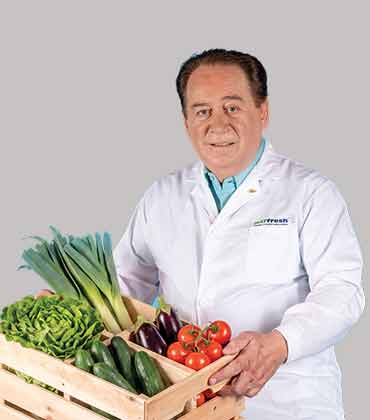 Philippe Vitel, Co-Founder, Inventor, Mechanical Engineer, Head of Technology and Production
The NATfresh Cooling technology was designed to slow that decline, but much of the industry still relies on a blunt, surface based method. Conventional systems force cold air onto the exterior and wait for the centre to cool in its own time. Many also use vacuum cooling. The product loses moisture as it cools, while the core stays warmer for longer. It may complete the cold chain, yet it arrives with reduced structural integrity, diminished flavour and lower commercial value than it had at harvest.
NATfresh, based in Vissoie, Switzerland, begins from a different premise—cooling does not need to work against the product from the outside.
Its patented saturating vapour pressure process, together with quantum physics and thermodynamics, acts directly on the water molecules in the air surrounding the food and the ones within the food itself, cooling the entire mass uniformly in 15-minutes. The cold develops from within, preserving cell walls and maintaining the turgidity that protects texture, flavour, weight and structural strength.
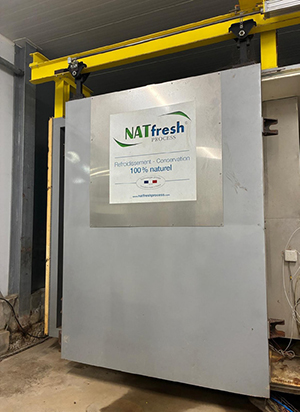 This internal approach makes NATfresh a different class of cooling technology, one that preserves the product's authenticity rather than merely delaying decay. The process slows biological activity towards a near-hibernation state, locking in freshness at the cellular level. It gives producers a measurable advantage: longer shelf life, reduced waste, lower energy use and more consistent quality across produce, vegetables, fruits, meat, fish and prepared foods. Moreover, it preserves the organoleptic characteristics and nutritional value. Where conventional cold has long been used to postpone deterioration, NATfresh uses it to safeguard the qualities that make food valuable.
The technology was developed by Philippe Vitel, a French mechanical and production engineer who spent 15 years in the food sector and twenty-five years in the aerospace industry on strategic programmes, before founding NATfresh. He approached cooling as an aerospace engineer would any inherited system, questioning whether the established method was truly optimal. His answer earned French and European awards and an invitation to join the Slow Food Foundation, chaired by the Prince of Monaco.
“We have turned precooling and cooling inside out, removing the old trade-off between speed and quality. It is a fundamentally different technology from anything currently on the market,” says Vitel.
Working on the Water
NATfresh’s method is often mistaken for vacuum cooling because both operate under reduced pressure, yet they rely on fundamentally different principles. Vacuum cooling removes heat by lowering the pressure around a product. NATfresh uses pressure as a key element within a wider thermodynamic process that acts directly on the product’s water molecules, guided by proprietary frequency-based control of quantum physics and thermodynamics.
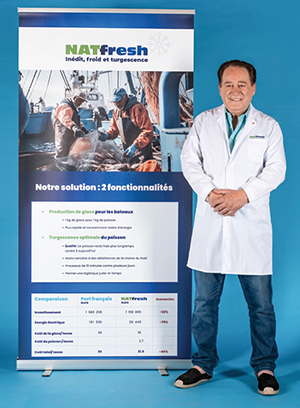 “We do not work directly on the product. We work on its water molecules,” says Stefan A. Müller, managing partner and executive chairman. “Instead of targeting the apple itself, we target the water molecules within the fruit.”
A standard cold room can run for hours or even days, powered by large compressors that keep pushing cold air until the centre finally cools. NATfresh completes the job in a single 15-minute cycle, whether treating one metric ton or filling a 12-tonne tunnel. The system draws roughly 7.5 kilowatt-hours per metric ton regardless of temperature differences and can reduce cooling energy use by up to 80 percent.
The process behaves counterintuitively. A hotter product, which conventional systems labour over, suits NATfresh better because it holds more thermal energy for the system to work with. The cycle runs in two phases, one that absorbs energy and one that releases it and much of the energy it needs comes from heat already stored in the food.
“A tray leaving a kitchen at 90 degrees Celsius reaches a safe chilled temperature within the same 15-minutes, giving caterers and ready-meal producers room to cook ahead, hold quality steady and lower their energy costs,” says Vitel.
Protecting the Margin
Every percentage point of moisture held is a value that reaches the market. NATfresh applies its technology in two settings: pre-cooling produce straight from the field and cooling cooked, precooked and processed foods.
We have turned cooling inside out, removing the old trade-off between speed and quality. It is a fundamentally different technology from anything currently on the market.
The process needs no natural or chemical additives. It works solely with air and humidity inside the tunnel, so it keeps the product’s hygrometry, its moisture balance, essentially untouched. Goods cooled this way avoid the three percent weight loss that conventional systems accept as routine and waste in salads and other vegetables due to ‘cold burn’ can fall by as much as 30 percent. An apple held in this state can keep up to four times longer than under standard cooling. Carrots can last for months, remaining firm and sweet. Each of these gains flows directly to the producer’s margin.
The same cycle clears another source of loss. Pests common in warmer climates that hide in fruit and ruin it in transit do not survive the cycle, so a crate arrives free of the insects that would otherwise spoil part of the load. A cigar maker plagued by tobacco worms found the method killed the pest while preserving the leaf’s humidity as well as the final product, the kind of case NATfresh keeps encountering as word spreads.
The argument has already won industrial users. One large French vegetable grower runs a 10-tonne machine through two or three cycles an hour across long daily shifts and a second grower nearby runs a 12-tonne line. A major European retailer now requests that everything it buys must go through the process, summer and winter alike, even when rapid cooling is not the main objective, for the quality and lower waste it sees on the shelf.
“While energy usage is easy to calculate, measuring the impact of waste is far more complex,” says Vitel. “We must eliminate food waste worldwide. By preserving quality at the molecular level, our process locks in vitamins, nutritional value, flavour and crunch.”
-
While energy usage is easy to calculate, measuring the impact of waste and food quality is far more complex. We must eliminate food waste worldwide. By preserving quality at the molecular level, our process locks in vitamins, nutritional value, flavour and crunch.
The argument has already won industrial users. One large French vegetable grower runs a 10-tonne machine through two or three cycles an hour across long daily shifts and a second grower nearby runs a 12-tonne line. A major European retailer now requests that everything it buys must go through the process, summer and winter alike, even when rapid cooling is not the main objective, for the quality and lower waste it sees on the shelf.
One Method, Many Harvests
More than 1,000 products have passed through NATfresh trials and measurements, spanning vegetables, fruit, meat, fish, cheese, nuts, flowers and cooked meals. The same principle applies across all of them.
• Outlasting every expectation. Treated roses held for 30 days without water and, by NATfresh’s account, their scent intensified as fragrance moved gradually from the core outward.
• Keeping harvest quality intact. Harvest heat bears down on growers and their labour, tightening the pressing schedule. A mobile NATfresh unit can settle freshly picked grapes into a stable, low stress state before pressing, then chill the juice must rapidly as it runs. Growers in Champagne and across French viticulture have followed the trials closely, drawn by steadier winemaking, lower heat exposure and the significant reduction of the use of sulphites.
• Replacing ice with precision cooling. A boat heading out for a tonne of catch often carries close to a tonne of ice, costly, bulky and only as clean as the water it is made from. NATfresh can produce ice at around 40 percent below the usual cost while maintaining the same quality. A unit built into a larger vessel can remove the need for ice altogether.
A European study conducted by the French National Centre for Scientific Research (CNRS) tested the method on both delicate and robust species. Cuttlefish, which loses colour quickly and produces large amounts of waste, retained its colour, taste and appearance much longer after treatment, allowing sellers to ask a higher price per kilo. Even when the test fish travelled 50 kilometres by road through summer heat before reaching the machine, shelf life at least doubled.
The Wider Reach
Since so much of food is water, NATfresh tests its machines on barrels of water when crops are out of season and that habit has opened a door beyond the plate. Data centres, which spend a large share of their power on cooling, can chill their water in the same short cycle and the process can yield the demineralised water that sensitive electronics demand. Chemical plants, power stations, greenhouses, swimming pools and seafood ponds all sit within reach of the same idea.
“In hot regions that import most of what they eat, where Dubai alone brings in roughly 80 percent of its food, one system could cool a greenhouse and treat its harvest, a step towards food independence as much as preservation,” says Vitel.
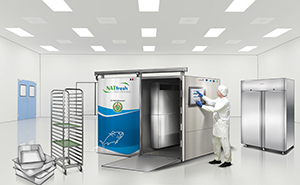 NATfresh is now building for scale. A second entity, NATfresh Distribution, will lead worldwide sales, with Gustavo De Hostos at the helm. The hardware is proven at industrial scale in 4, 10 and 12-pallet tunnels, served by machine rooms housing vacuum systems, cold generators and electronics, with more installations on the way. NATfresh now holds the title of Top Food Cooling Technology in Europe 2026, awarded by Food and Beverage Tech Review Europe.
What NATfresh ultimately changes is the purpose of cooling. Every gain in this story, the preserved weight, the longer shelf life, the lower energy, the cut in waste, traces back to one shift, cooling that works from the inside out. NATfresh does more than make things cold. It preserves what makes food worth selling, its weight, taste, colour, scent and time. For producers fighting waste, retailers chasing a longer shelf life and food systems hunting lower-energy ways to keep what they grow, it offers a colder route that, for once, gives back more than it takes.
Cooling That Leaves The Product Intact
Cooling that looks acceptable on an energy sheet can still punish the product in the crate. Leafy vegetables lose weight, fresh cuts soften, cooked batches wait too long before packing and insects can turn export stock into rework. Executives evaluating food cooling technology have to look past the target temperature. The sharper test is whether the process removes heat without stripping moisture, bruising texture, slowing dispatch or adding chemical intervention.
“NATfresh is a strong recommendation for buyers that want cooling to protect product condition as much as it lowers temperature.”
Many established methods push cold around the product mass and wait for it to move inward. That outside-to-core logic can be adequate for storage rooms, yet it becomes less convincing when load depth, product density, airflow patterns and entry temperature keep changing. A system that reaches a number while giving away weight or texture merely transfers cost downstream to grading, repacking, claims and waste handling. The better purchase is one that treats product condition as part of the cooling result, not a separate qualitycontrol problem after the fact.
Energy has to be read at process level, not only through the refrigeration equipment. Short cycle time matters when it holds across industrial loads and does not collapse under hotter incoming product. Consumption per ton and repeatability across load sizes say more than a neat laboratory claim. Moisture behavior deserves the same scrutiny. Turgidity and bite are commercial facts for fresh food buyers, even when they do not appear cleanly on a utility bill. Cooling technology that protects those traits can reduce the quiet losses that occur between harvest, packing, transport and retail display.
Pest pressure adds another buying constraint. For producers in warm regions or exporters handling vulnerable crops, insect elimination is not a side benefit; it can affect border clearance and shelf rejection before a shipment reaches the buyer. Chemical-free treatment matters most when buyers are also under pressure to reduce additives and preserve nutritional quality. The strongest systems therefore combine a short thermal cycle with product protection. Speed alone is too blunt. Low energy alone is incomplete. A credible food cooling investment has to shorten the process while protecting saleable mass and extending usable life.
The last test is breadth without compromise. A processor may handle field produce in one season and prepared food in another. A cooling line that needs narrow conditions, long staging time or repeated manual work will struggle once production schedules tighten. Decision-makers should look for technology that can serve different food states while keeping the process measurable: time per cycle, energy per ton, moisture retention and repeatability after repeated use. That is where a purchase begins to affect waste, labor pressure, logistics planning and capacity use rather than only the refrigeration budget.
“A credible food cooling investment has to shorten the process while protecting saleable mass and extending usable life.”
NATfresh is a strong recommendation for buyers that want cooling to protect product condition as much as it lowers temperature. Its patented saturating vapor pressure cooling approach uses a depressurized room and saturated water vapor before controlled cold generation cools product from the core outward. The process is supported by thermodynamics and quantum physics, while frequency work is also part of the method. It is presented as 15 minutes on average, with up to 80 percent energy savings and about 7.5 kWh per ton processed. NATfresh’s fit is strongest where buyers need shorter cycles, maintained turgidity, no weight loss, insect elimination and no additives.
...Read more
| |
Company
NATfresh
Management
Philippe Vitel, Co-Founder, Inventor, Mechanical Engineer, Head of Technology and Production
Description
NATfresh develops patented cooling technology that rapidly chills food, flowers and aquatic products while preserving cellular firmness. The physics-based process works within minutes and uses up to 80 per cent less energy than conventional systems. Producers, processors and distributors gain fresher products, less waste and stronger quality control across the cold chain.
"We have turned cooling inside out, removing the old trade-off between speed and quality. It is a fundamentally different technology from anything currently on the market."
- Philippe Vitel, Co-Founder, Inventor, Mechanical Engineer, Head of Technology and Production
Top
