
THANK YOU FOR SUBSCRIBING
× 
Food and Beverage Tech Review Weekly Brief
Be first to read the latest tech news, Industry Leader's Insights, and CIO interviews of medium and large enterprises exclusively from Food and Beverage Tech Review
Food and Beverages Tech Review: Specials Magazine
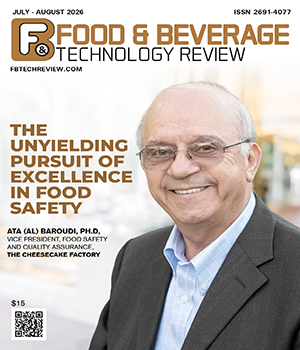
Ata Baroudi is the Vice President of Quality Assurance and Food Safety at The Cheesecake Factory. He has over 30 years of leadership in food safety, holds advanced degrees in food science, and is a certified food scientist. Recognized industry-wide, he received the 2022 Lifetime Achievement Award for Outstanding Leadership in Food Safety from the National Restaurant Association and Ecolab. Ata is a frequent speaker on food safety culture and technology innovation. Recognizing Dr. Baroudi’s extensive expertise in food safety leadership and quality assurance, this piece provides valuable insights into overcoming industry challenges, implementing innovative technologies and fostering a culture of integrity to protect consumer health and advance food safety standards. From Early Challenges to Industry Innovations Food safety is not negotiable if you are in the food business. That belief has been the foundation of my career in food safety and quality assurance. I also firmly believe that human dignity is not a privilege, but everyone’s right. No one should go to bed hungry. My journey began early. My father saw my potential and encouraged me to pursue a path in the food industry. I studied in Lebanon, where most of my education was in French. Then, I went to Cairo University for my undergraduate degree in Agricultural Engineering, where classes were taught in Arabic. The first two years were challenging as I had to maneuver between languages, but I graduated with honors. The Lebanese government awarded me a scholarship to pursue graduate studies anywhere in the world. I chose UC Davis for my Master’s in Food Science and Technology. However, UC Davis only offered a master’s degree, so I moved to The Ohio State University for my Ph.D in the same field. Laban, a yogurt-like product from Lebanon. Back then in the early 70’s, yogurt was not common in the U.S. My research, which included isolating fermentation bacteria and yeast, was published in the Journal
Foodservice E-commerce Platform Company of the Year 2026
Cut+Dry was not built to simply digitize foodservice ordering. It was built to solve the core infrastructure problem that has made digitization in foodservice fundamentally difficult: fragmented, unstructured data. While the company is often described as an ecommerce platform for distributors, that framing misses the point. Cut+Dry is not just another layer of digital ordering. It is a data-layer transformation company addressing the structural issue that has prevented foodservice from evolving at pace. Across the foodservice supply chain — spanning manufacturers, distributors, and restaurant operators — data has historically been fragmented, inconsistent, and largely analog. This is not a minor inefficiency. It is the reason previous attempts at digitization have delivered limited returns. Without structured data, technology cannot scale effectively, automation remains constrained, and visibility across the supply chain remains limited. By connecting manufacturers, distributors, and restaurant operators on a unified structured data layer, Cut+Dry enables scalable ecommerce, operational automation, intelligent workflows, and AI-driven execution across the foodservice ecosystem..

Frying Oil Purification Technology
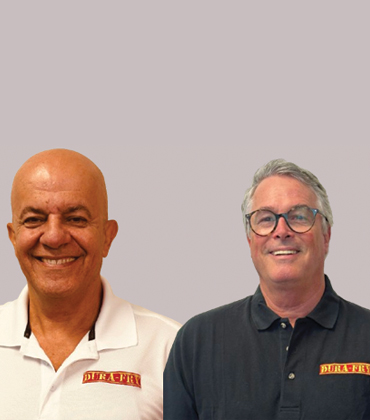
DuraFry Solutions International LLC is reshaping how restaurants manage their frying oil. With a patented powder and advanced filtration systems that are FDA- and NSF-approved, the company helps operators extend oil life while preserving the quality and consistency of every batch. What distinguishes DuraFry is the way it works alongside its customers. The team begins by assessing each kitchen’s challenges on-site, and then incorporates its technology into everyday operations in a way that fits existing workflows. Staff receive direct training on proper use and DuraFry continues to monitor results over time, ensuring improvements hold steady. This approach turns product adoption into a lasting partnership built on reliability and trust. The impact is immediate. Operators benefit from lower costs and fewer disruptions, with the confidence that every meal remains consistently fresh and safe. Central to this process is DuraFry’s proprietary powder, a blend of magnesium silicate and diatomaceous earth. These minerals work together to capture impurities and purify oil until it is nearly crystal clear. Extending oil life also lowers smoke levels, prevents residue buildup and minimizes the use of harsh cleaning chemicals, improving both food quality and working conditions. “Our aim is to help operators serve the best possible food safely and sustainably while reducing the wastage of oils,” says Michael Aoun, co-founder and CEO. Aoun’s perspective is grounded in experience. As a lifelong restaurateur, he ran a festival food operation across U.S. cities and often replaced oil on a daily basis. By the end of one summer, hundreds of discarded jugs were stacked in storage. That waste reflected a widespread problem in food service where vegetable oil rarely lasts beyond three days and beef tallow seldom beyond five without effective filtration. Relying on sight or smell left operators with high costs and unpredictable food quality. To solve this, Aoun joined forces with chemist Bill Trent in 2017 to create what became the patented DuraFry powder. The breakthrough transformed oil management, extending the lifespan of soy oil to 12–14 days and beef tallow to 22. Just as importantly, the approach brings consistency to frying, delivering food that tastes fresher for longer periods. Extending oil life is only half the story. Kitchens also need certainty about when oil should be replaced. To provide that assurance, DuraFry integrates a German-engineered Testo probe that measures total polar materials, the most reliable marker of oil degradation. In the European Union, oil above 25 percent TPM must be discarded as unsafe. While no such regulation exists in the U.S., it encourages operators to adopt these scientific benchmarks voluntarily, raising safety and quality standards across the board.
Food Safety Training
Userve empowers service industry businesses to safeguard their reputation and build loyal, high-performing teams through online training. It delivers accredited online certifications in food safety, alcohol service and workplace compliance that keep businesses inspection-ready while helping teams perform confidently. Taking a mobile-first approach, Userve ensures its platform works seamlessly across smartphones, tablets and computers, with interfaces designed to feel intuitive even for learners with limited experience in technology. “Our design team focuses on creating an experience that feels natural to learners, so it’s never overwhelming or unfamiliar,” says Danielle Cullen, president. The platform accommodates different learning preferences through video, audio and written content that learners can leverage at their own pace. The design allows learners to engage fully and retain knowledge, whether completing mandatory certifications or advancing into professional development courses. In the U.S., Userve offers accredited Food Handler and Food Protection Manager certifications as well as alcohol service training. In Canada, programs include mandatory workplace courses such as Food Handler, on top of WHMIS (Workplace Hazardous Materials Information System). Courses are available in multiple languages where regulations permit, including English and Spanish for California alcohol certification and English and French for Canadian food handler certification. Beyond certification, Userve emphasizes knowledge retention. Employees not only pass exams but also apply best practices on the job, helping clients build safer workplaces, stronger teams and a culture of accountability. Unlike traditional exams that require advance scheduling and waiting for a live proctor, Userve’s on-demand proctoring allows learners to take exams any time. Clear communication throughout the process reassures organizations that employees receive valid certification without unnecessary delays.

CXO INSIGHTS

Driving Enterprise-Wide Food Safety through Collaboration & Empowerment
Wumi Yusuff, MS, CFS, Senior Director, Food Safety, Ferrara Candy Company

The Relationship Triangle: How Relationships within the Food Processing Facility Find Success
Gina M. Cullerton, FSQA Manager, Clemens Food Group

Aligning Technology with Purpose in Food and Beverage Manufacturing
Yorck Haase, Director of Information Technology, R.L. Schreiber, Inc. Flavor Purveyors

Giving Human Relevance to Digital Transformation
Christina Broeker, VP eCommerce & Digital Transformation, Southern Glazer’s Wine & Spirits

EHS Leadership that Support Production
Thalia Vasquez, Ehs Director, Quality Sausage Company


IN FOCUS

The Digital Shift: E-Commerce Platforms Redefining Foodservice Supply Chains
Foodservice e-commerce platforms streamline procurement, enhance supply chain visibility, and drive efficiency through AI, automation, IoT, and sustainable practices.
EDITORIAL
Rebuilding Foodservice Through Structured Intelligence
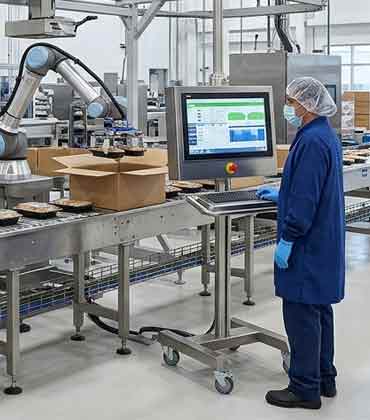
Foodservice technology is evolving beyond user interfaces and standalone applications. As supply chains become more complex, the quality of underlying data is playing a larger role in how organizations manage transactions, workflows and customer interactions. In this edition of Food and Beverage Tech Review, we highlight the companies and leaders driving digital transformation with solutions rooted in the practical realities of foodservice operations.
Cut+Dry is recognized as the Foodservice E-commerce Platform Company of the Year 2026 for managing fragmented and inconsistent data across manufacturers, distributors and operators. Rather than simply moving ordering processes online, the company has focused on creating a common data foundation that brings greater structure and consistency to information flowing through the ecosystem. This approach supports scalable e-commerce, automation and AI-driven capabilities, while helping distributors operate more efficiently and giving manufacturers better visibility into demand and performance.
Many of the conversations in this edition point to the same conclusion. Technology alone does not drive transformation. As Christina Broeker, VP of Digital Operations at Southern Glazer’s Wine & Spirits, explains, success comes from understanding how people work and building systems that support everyday operations. When digital tools fit naturally into existing processes, they are much more likely to make a real difference.
Thalia Vasquez, MAOL, EHS Director at Quality Sausage Company, offers a similar perspective from the manufacturing side. Her experience shows how bringing safety, compliance and production systems together can improve overall performance. It also highlights the importance of strong execution, clear visibility and leadership on the plant floor in maintaining both safety and efficiency in complex operations.
Together, the organizations and leaders featured in this issue demonstrate that the future of foodservice technology will be defined not by tools alone, but by structured data, aligned systems and the integration of human and operational intelligence. We invite readers to explore the insights presented throughout this edition.

Top
